News & Cases

Digitizing Learning Assessment IV: A Whole-Class Learning Performance Summary

Publication No.:HB20220122E
Published:January 22, 2022
Updated:August 18, 2026
Automate repetitive data work so teachers can focus on instructional decisions and personalized support

Digital transformation should do more than move paper-based work onto a screen. Its greater value lies in automating repetitive data collection, consolidation, and reporting. In a 1:1 tablet classroom powered by HiTeach, teachers can take attendance, award performance points, run interactive questions, distribute assignments, and administer assessments. When the lesson ends, HiTeach consolidates these activities into a whole-class performance summary and an exportable Excel report, giving teachers a timely view of each learner's participation and progress.

Teacher reviewing a whole-class learning performance dashboard in a HiTeach smart classroom
Figure 4-1. Five streams of classroom activity converge into one actionable learning performance overview.
Capture During Class Record attendance, points, interactions, assignments, and assessments as learning happens.
Summarize at Lesson End Automatically generate a whole-class overview together with learner-level details.
Analyze and Retain Export an Excel report or send the lesson record to IES for longitudinal analysis.

1. Five Sources of Classroom Learning Performance Data

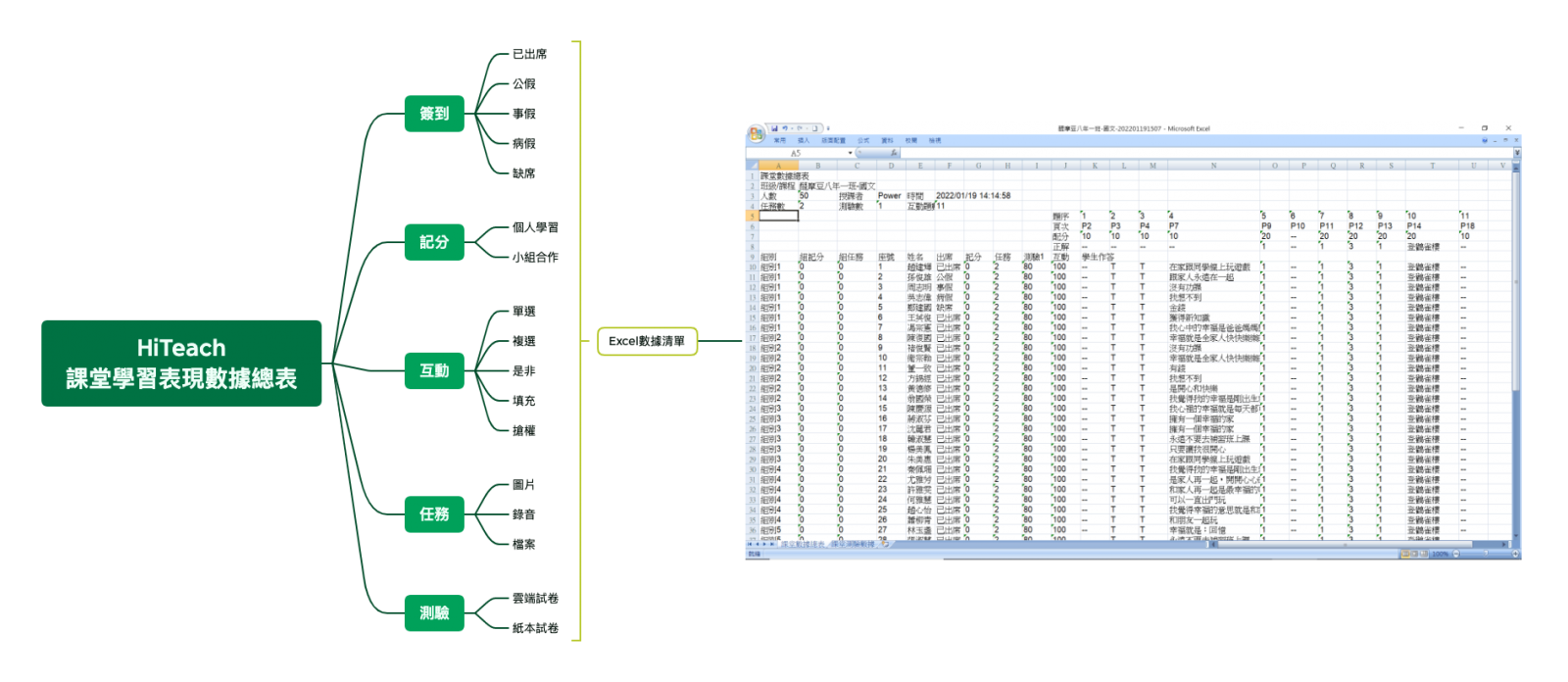
HiTeach continuously organizes five types of evidence generated through everyday teaching activities. Together, they show not only what students achieved, but also how they participated, responded, and completed learning tasks during the lesson.

1. Attendance Tracks presence, absence, late arrival, sick leave, personal leave, and official leave for quick review and export.
2. Performance Points Consolidates points awarded to individuals or groups, including positive reinforcement and other performance records.
3. Interactive Response System (IRS) Captures participation and results from single-answer, multiple-answer, true/false, cloze, and buzz-in activities.
4. Assignments Tracks distribution and submission status while retaining the images, files, and other work students return in class.
5. Assessments Combines results from cloud-based tests, paper assessments, and in-class checks to provide both item-level and learner-level evidence.

After selecting End Lesson, the teacher receives an automatically generated whole-class summary. For deeper analysis, the complete classroom data report can be exported from the Learning Performance window. Lesson records can also be sent to IES Smarter Learning Service to build a continuous learning record for each class and student.

HiTeach whole-class learning performance summary
Figure 4-2. Whole-class learning performance summary.
Excel classroom learning performance data report exported from HiTeach
Figure 4-3. Classroom learning performance data exported to Excel.

2. Monitor the Class in Real Time

Teachers can open Learning Performance from the course information area in HiTeach and move among the Attendance, Points, and IRS views. Because the data is organized while the lesson is still in progress, teachers can identify participation gaps early and adjust instruction before the class ends.

Attendance: Confirm Presence and Leave Status

The Attendance view presents the status of the entire class in one place, making it easy to identify students who have not checked in or whose attendance records require an update.

Attendance view in the HiTeach Learning Performance window
Figure 4-4. Attendance view in the Learning Performance window.

Points: Review Individual and Group Performance

Points awarded or deducted during class are consolidated immediately. Teachers can review individual and group totals to support positive reinforcement, classroom management, and timely feedback.

Points view in the HiTeach Learning Performance window
Figure 4-5. Individual and group points in the Learning Performance window.

IRS: See Participation and Response Patterns

The IRS view brings together results from live questions and feedback activities. Teachers can quickly see who participated and how the class responded across different question formats.

IRS interaction view in the HiTeach Learning Performance window
Figure 4-6. Participation and response records in the IRS view.

3. Generate a Whole-Class Summary When the Lesson Ends

When the teacher selects End Lesson, HiTeach displays a learning performance summary covering attendance, points, interactions, assignments, and assessments from that session. The teacher can review the information immediately or select Paste to place the summary on a HiTeach page for lesson reflection, instructional review, or follow-up sharing.

Learning performance summary notification displayed when a HiTeach lesson ends
Figure 4-7. Learning performance summary notification at the end of a lesson.
Whole-class learning performance summary pasted onto a HiTeach page
Figure 4-8. Pasting the whole-class summary onto a HiTeach page.

4. Export the Complete Classroom Data Report to Excel

For recordkeeping, deeper analysis, or comparisons across lessons, teachers can export the complete classroom learning performance report from the Learning Performance window. The workbook organizes class-level information and student-level details by data type. Student work collected during the lesson is packaged with the report, eliminating the need to download and organize each submission manually.

Workflow tip: Open the Learning Performance window and select the export function to obtain the classroom data workbook and packaged student submissions. The resulting files can be filtered, summarized, archived, or incorporated into further analysis according to local teaching needs.

HiTeach classroom data report page
Figure 4-9. Classroom data report page in HiTeach.
Classroom assessment data in the exported Excel report
Figure 4-10. Classroom assessment data in the exported Excel workbook.
Excel export containing HiTeach classroom interaction records
Figure 4-11. Exported classroom interaction records and detailed response data.

For a closer look at the Excel fields used for classroom interaction records and the contents of packaged student submissions, see the FAQ on classroom records and data reports.

5. Turn Learning Records into Instructional Action

Since HiTeach 5.0.12, classroom learning performance data can be consolidated automatically when a lesson ends. The visual summary gives teachers an immediate whole-class perspective, while the Excel report supports closer analysis of individual differences. Used together, they reduce administrative work and provide stronger evidence for follow-up support, instructional adjustment, and communication with families.

Record every step and make the learning process visible. When classroom interactions are captured consistently and systematically, assessment becomes more than a one-time score. It becomes actionable evidence for understanding progress and responding to learner needs.

Resources and Further Reading

Original Chinese article: Written by Prof. Power Wu, founder of TEAM Model Smarter Education Theory and Practice, and published on the TEAM Model blog.

Read the original article in Traditional Chinese.

Keywords:digital learning assessment, HiTeach, classroom learning performance, learning analytics, Excel data report, smart classroom, IES
TOP